
It sets out how facilities should prepare for emergencies — including evacuation procedures, training, and the information displayed on evacuation diagrams. While it’s not legislation, it’s widely recognised as the benchmark used by fire safety professionals, building managers, and inspectors across Australia.

Fire Safety Evacuation Diagrams Built for Compliance
Clear, professional evacuation diagrams prepared in accordance with AS 3745-2010 by a qualified Fire Safety Advisor — delivered Australia-wide without site visits.
Send your floor plans, photos, or existing diagrams. We handle the rest and deliver print-ready PDFs within 3–5 business days. Optional A3 printing and delivery available.
Fire Safety & Emergency
Evacuation Diagrams
✓AS 3745-2010 compliant
✓Correct orientation & exit paths
✓Audit-ready diagrams
✓Australia-wide digital delivery
Compliant Elements on Evacuation Diagrams
Every evacuation diagram prepared by EvacNow aligns with the requirements of AS 3745-2010 and includes

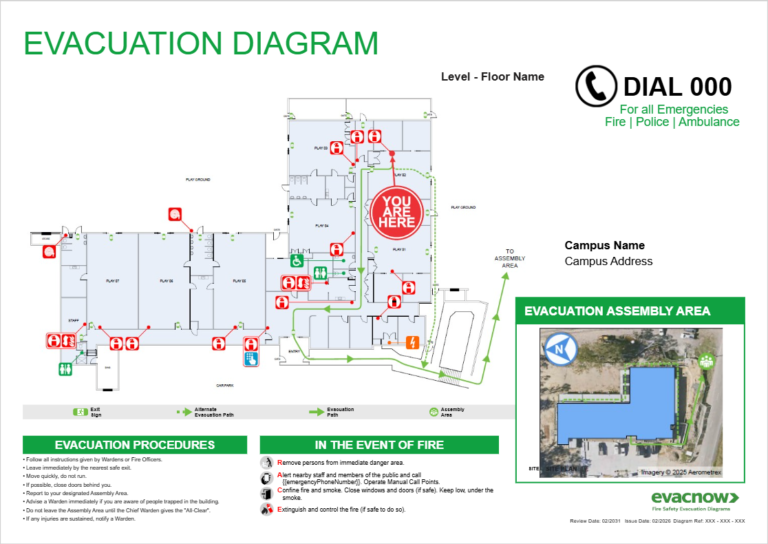
A clear marker showing the exact location where the diagram is displayed. Must correspond precisely to the physical location in the building

Locations of relevant firefighting equipment, including (where applicable), Fire extinguishers, Fire hose reels, Fire blankets, Fire Hydrants,

The diagram must be orientated to match the viewer’s perspective. The top of the diagram must represent the direction the viewer is facing.

Clearly identified locations of manual call points (break glass alarms), if installed
Clearly shown main evacuation route. Clearly shown alternate evacuation route(s)

Other Emergency Equipment (Where Applicable). Defibrillators (AEDs), Emergency showers, Eyewash stations, Spill kits. (These are included when present and relevant)

All required exits clearly identified. Exit paths must lead occupants safely out of the building

Designated assembly area(s) clearly identified. Evacuation routes from exits to the assembly area(s) shown where applicable

A legend explaining symbols used on the diagram. Each evacuation diagram must include, Diagram issue date, Diagram validity date.
What Makes a Evacuation Diagram AS 3745-2010 Compliant?
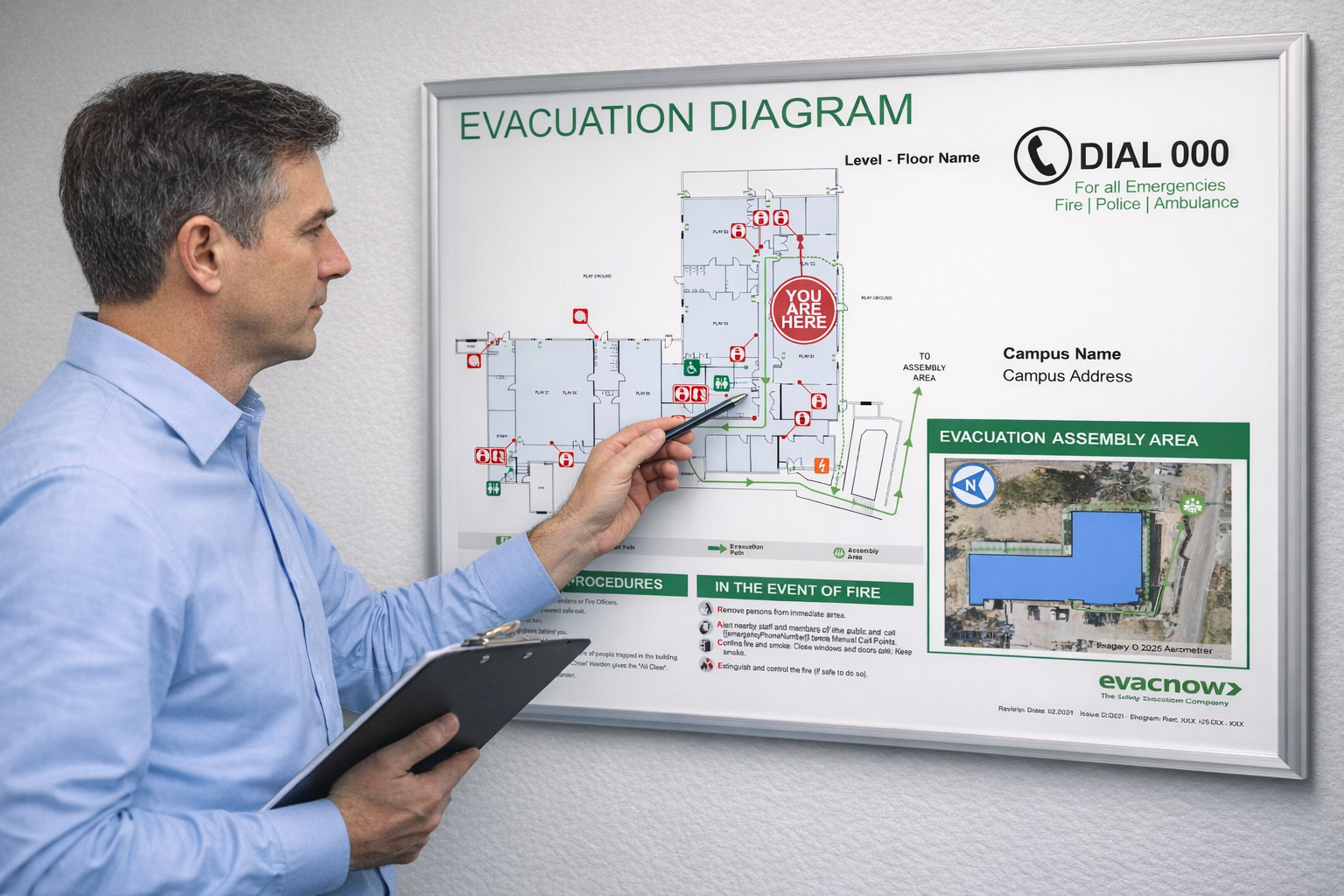
A compliant evacuation diagram must clearly show the occupant’s current location with a visible “You Are Here” marker, and be oriented to match the viewer’s perspective so it can be easily understood at a glance. Exit points and evacuation routes must be clearly identified, including both primary and alternate paths of travel.
The diagram should also display the location of key fire and emergency equipment such as fire extinguishers, hose reels, hydrants, manual call points, first aid kits, and defibrillators where applicable. Assembly area locations must be shown, along with a clear legend explaining all symbols used throughout the diagram.
Finally, each diagram must include an issue date and a validity date to ensure it remains current and suitable for use as part of the building’s emergency planning.
What Is AS 3745-2010?
AS 3745-2010 is the Australian Standard for emergency planning in buildings.
✓ Defines what must be shown on evacuation diagrams
✓ Outlines how occupants should respond in an emergency
✓ Covers roles like wardens and emergency control organisations (ECO)
✓ Recommends training, evacuation drills, and review timeframes
✓ Provides guidance on diagram placement and visibility
All evacuation diagrams provided by EvacNow are prepared in accordance with AS 3745-2010. (like to know more?)
How It Works
Our Process for Creating Evacuation Diagrams
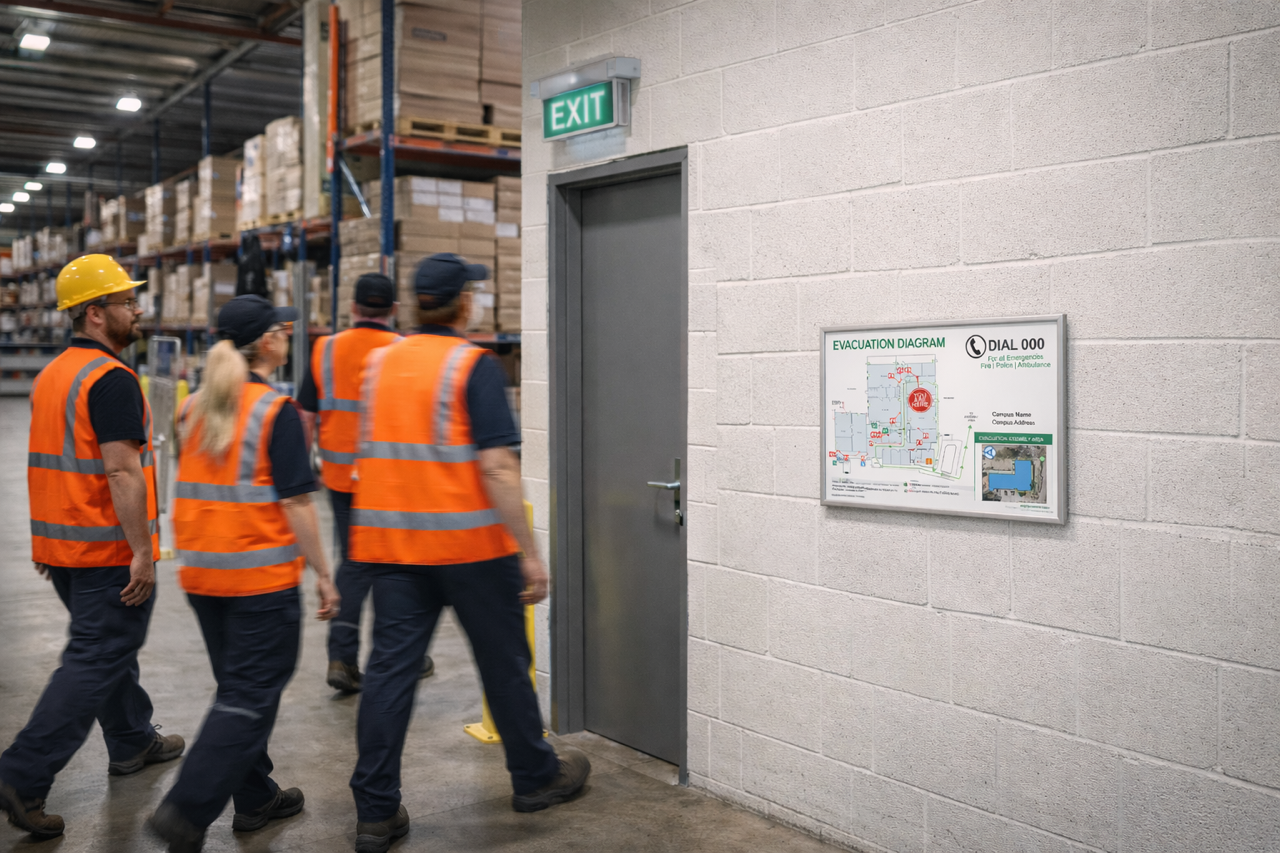
Evacuation Diagrams Digital Delivery Australia-Wide
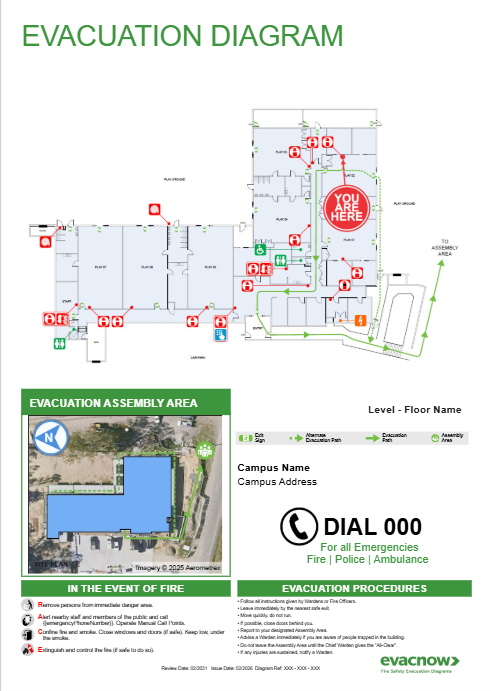
We deliver AS 3745-2010 compliant evacuation diagrams digitally to businesses across Australia — fast, simple, and without the need for site visits.
Each diagram is supplied as a high-resolution, print-ready PDF. We also offer optional A3 printing, snap frames, and delivery, so you have everything needed for compliant installation on site.
Evacuation Diagrams FAQ
How many evacuation diagrams does my building require?
The number of evacuation diagrams required depends on the size, layout, and occupancy of the building. Under AS 3745-2010, evacuation diagrams must be displayed in prominent and strategic locations such as near exits, stairwells, lifts, corridors, and areas where occupants gather.
Each level of a building typically requires multiple diagrams to ensure they are clearly visible from any point of travel. A certified Fire Safety Advisor can determine the correct number and placement to ensure full compliance.
Are evacuation diagrams legally required in Queensland?
Yes. In Queensland, certain buildings are legally required to display evacuation diagrams under fire safety and workplace health and safety regulations. These diagrams must comply with AS 3745-2010 – Planning for Emergencies in Facilities.
Commercial buildings, multi-occupancy properties, and high-traffic facilities are typically required to have compliant evacuation diagrams clearly displayed to assist occupants during an emergency.
Do evacuation diagrams need to comply with AS 3745?
Yes. Evacuation diagrams must comply with AS 3745-2010, the Australian Standard that governs emergency planning and evacuation procedures in facilities.
The standard specifies required elements including:
- Orientation (“You Are Here” marker)
- Emergency exits and paths of travel
- Fire safety equipment locations
- Assembly areas
- Emergency contact details
- Required symbols and formatting
Non-compliant diagrams may not meet regulatory requirements and could place building owners at risk.
Can evacuation diagrams be prepared without a site visit?
In many cases, yes. Evacuation diagrams can be prepared remotely using accurate and up-to-date floor plans, building layouts, and emergency equipment details.
However, site verification may be recommended if floor plans are outdated or if there are complex fire safety installations that require confirmation. Our process allows for fully online preparation while ensuring compliance with AS 3745-2010.
How long does it take to receive evacuation diagrams?
Turnaround time depends on the building size and complexity. For most standard commercial or multi-occupancy buildings, evacuation diagrams are typically prepared and delivered within a few business days after receiving complete and accurate floor plan documentation.
Urgent requests can often be accommodated upon request.
Can you prepare evacuation diagrams outside Brisbane?
Yes. We prepare AS 3745-2010 compliant evacuation diagrams for buildings across Australia. Our process is fully online, allowing us to deliver professionally prepared, print-ready evacuation diagrams regardless of location.
We regularly assist clients in Brisbane, Queensland, and nationwide.

