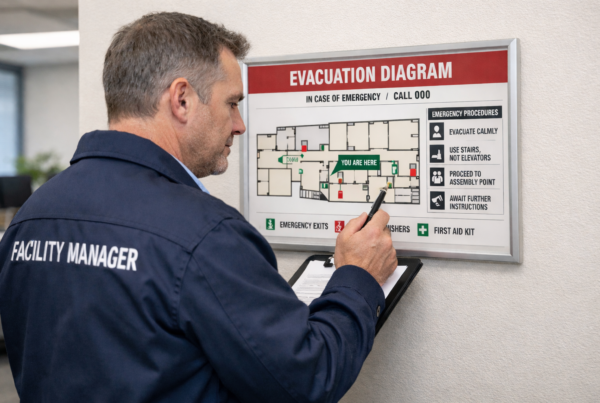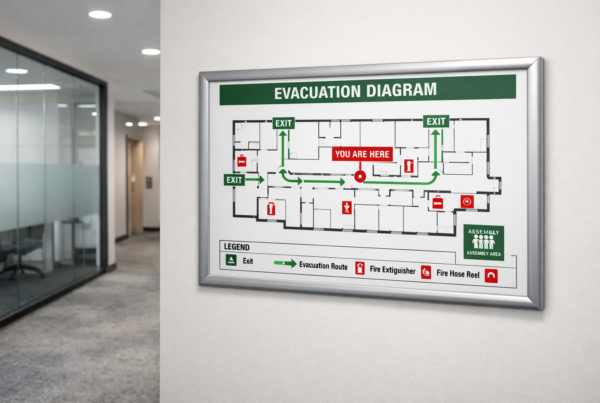

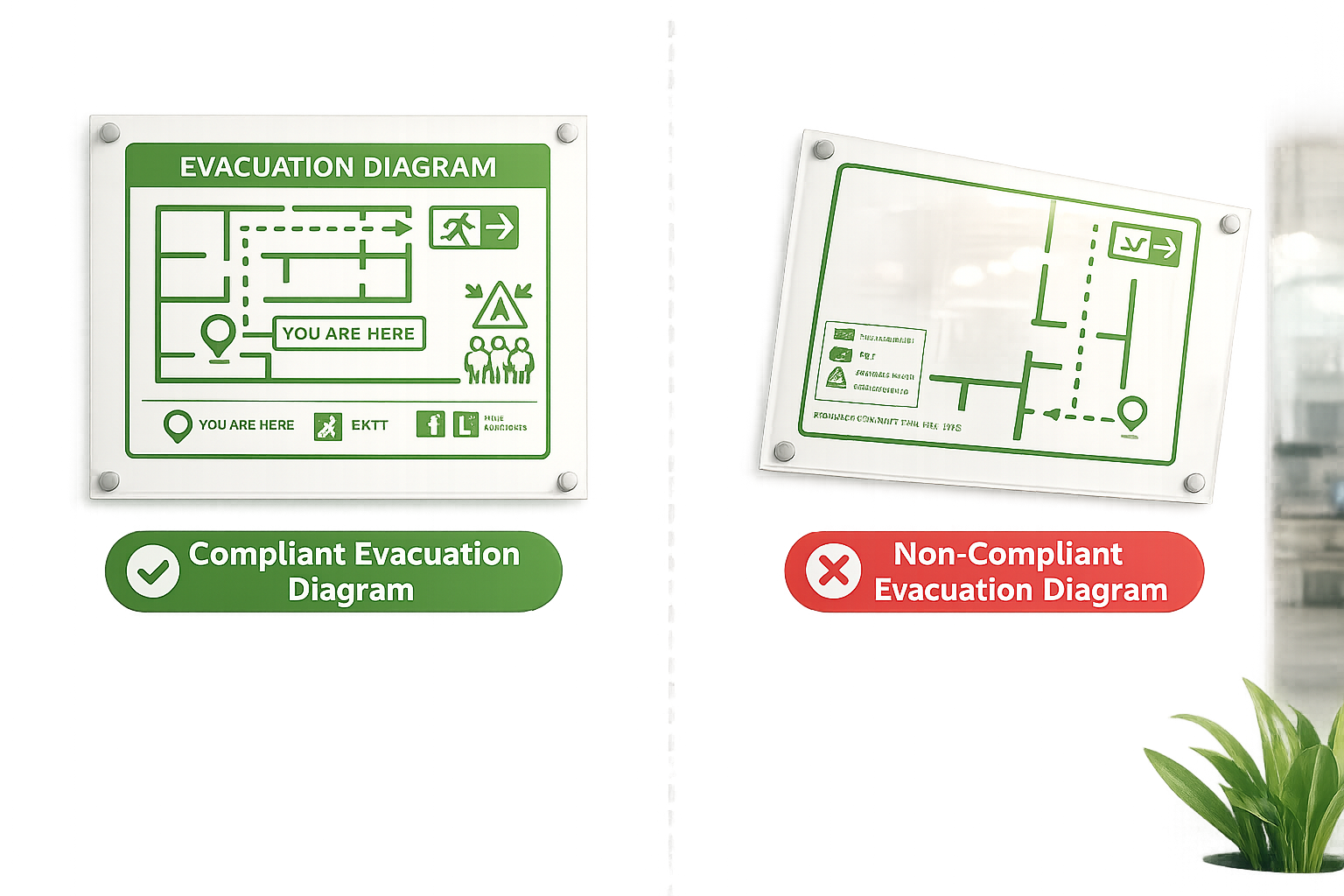
When a fire audit or safety inspection is scheduled, most facility managers focus on extinguishers, alarms, and test tags. But one of the most common causes of non-compliance? Evacuation diagrams. Poorly prepared, outdated, or incorrectly displayed evacuation diagrams are regularly flagged during inspections across Australia. And the frustrating part? These issues are usually avoidable. If you manage a commercial building, office, warehouse, or small business, here are five common evacuation diagram mistakes that can cause problems during a fire audit — and how to avoid them.
1. Incorrect Orientation (“You Are Here” Is Wrong)
One of the most frequent compliance failures is incorrect diagram orientation.
Under AS 3745 – Planning for Emergencies in Facilities, evacuation diagrams must be displayed in a way that matches the viewer’s perspective. If someone stands in front of the diagram, the exits shown should match the direction they would physically walk.
If the map is rotated incorrectly:
- Left appears as right
- Exits appear in the wrong direction
- Occupants become confused during emergencies
In an audit, this is an immediate red flag.
How to avoid it:
Ensure evacuation diagrams are prepared specifically for the wall location where they will be installed — not just copied and reused generically.
2. Missing Required Information Under AS 3745
Evacuation diagrams must include specific elements to be compliant.
Common missing items include:
- “You Are Here” indicator
- Evacuation routes
- Fire equipment (extinguishers, hose reels, alarms)
- Emergency assembly area
- North point
- Diagram issue date
- Review period
If even one of these elements is missing, the diagram may be considered non-compliant.
How to avoid it:
Have your evacuation diagrams prepared by someone familiar with AS 3745 requirements rather than relying on outdated templates.
3. Outdated Layouts After Renovations or Changes
Buildings evolve. Tenancies expand. Walls move. Equipment relocates.
But evacuation diagrams often don’t get updated after:
- Office fit-outs
- Refurbishments
- Exit changes
- Equipment relocation
- Tenancy reconfiguration
During an audit, inspectors will compare the physical layout to the displayed diagram. If they don’t match — that’s a compliance issue.
How to avoid it:
Evacuation diagrams should be reviewed:
- At least every 5 years
- Immediately after layout or equipment changes
If the building has changed, the diagrams must change too.
4. Poor Placement or Visibility
Even perfectly prepared evacuation diagrams can fail an audit if they are not displayed correctly.
Common placement issues:
- Installed too high or too low
- Hidden behind doors or furniture
- Placed in low-traffic areas
- Faded or damaged
AS 3745 requires evacuation diagrams to be displayed in prominent and accessible locations where occupants can easily view them.
How to avoid it:
Install evacuation diagrams:
- Near exits
- In corridors
- In lift lobbies
- In common areas
- Inside larger tenancies
They must be clearly visible and legible.
5. Using Generic or DIY Templates
Downloading a free template or reusing a diagram from another site may seem cost-effective — but it often leads to audit failure.
Common DIY problems:
- Incorrect symbols
- Non-standard legend
- Missing compliance details
- Incorrect scale
- Poor readability
Fire audits don’t assess “effort” — they assess compliance.
How to avoid it:
Ensure your evacuation diagrams are:
- Prepared to Australian Standards
- Professionally formatted
- Clear and easy to interpret
- Site-specific
Why This Matters
During a fire audit, evacuation diagrams are part of your broader emergency planning compliance.
If they are incorrect or missing:
- You may receive a non-compliance notice
- Rectification deadlines may be issued
- Liability exposure increases
- Insurance questions may arise
Most importantly — in an actual emergency, confusion costs time.
The Simple Way to Avoid Audit Failures
Modern services allow facility managers and business owners to:
- Upload floor plans online
- Have compliant evacuation diagrams prepared remotely
- Receive print-ready files
- Update diagrams when layouts change
- Stay aligned with AS 3745
Clear, compliant evacuation diagrams are one of the simplest ways to reduce risk and strengthen your emergency preparedness.
Fire audits don’t just look at extinguishers and alarms — they look at the clarity of your evacuation instructions.
If your evacuation diagrams are:
- Outdated
- Incorrectly oriented
- Missing required information
- Poorly displayed
…you’re at risk of failing a compliance check.
Fixing it is straightforward — and far less stressful than responding to a non-compliance notice.
FAQ – Evacuation Diagram Compliance
What causes evacuation diagram audit failures?
Evacuation diagram audit failures are usually caused by incorrect orientation, missing AS 3745 requirements, outdated layouts, poor placement, or use of non-compliant templates.
How often should evacuation diagrams be reviewed?
Under AS 3745, evacuation diagrams should be reviewed at least every five years or immediately after layout or equipment changes.
What does AS 3745 require on evacuation diagrams?
AS 3745 requires evacuation diagrams to include a “You Are Here” indicator, evacuation routes, fire equipment locations, emergency assembly area, north point, issue date, and review period.