
How often update evacuation diagrams? It’s one of the most common compliance questions facility managers and business owners ask. Under Australian Standard AS 3745-2010, evacuation diagrams must be reviewed at least every five years — and sooner if changes occur.
If you manage a commercial building, office, warehouse, or retail site, understanding how often to update evacuation diagrams is essential for staying compliant and avoiding audit issues.
What Does AS 3745-2010 Say?
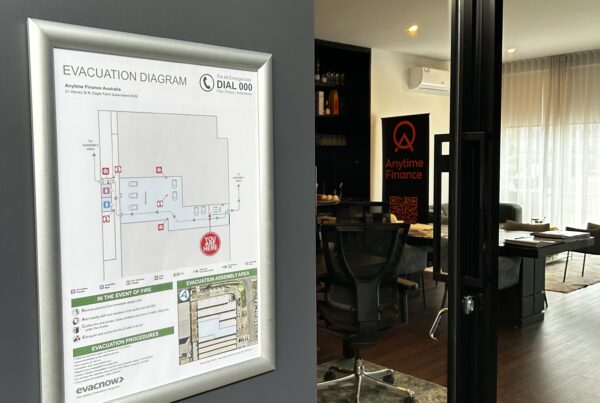
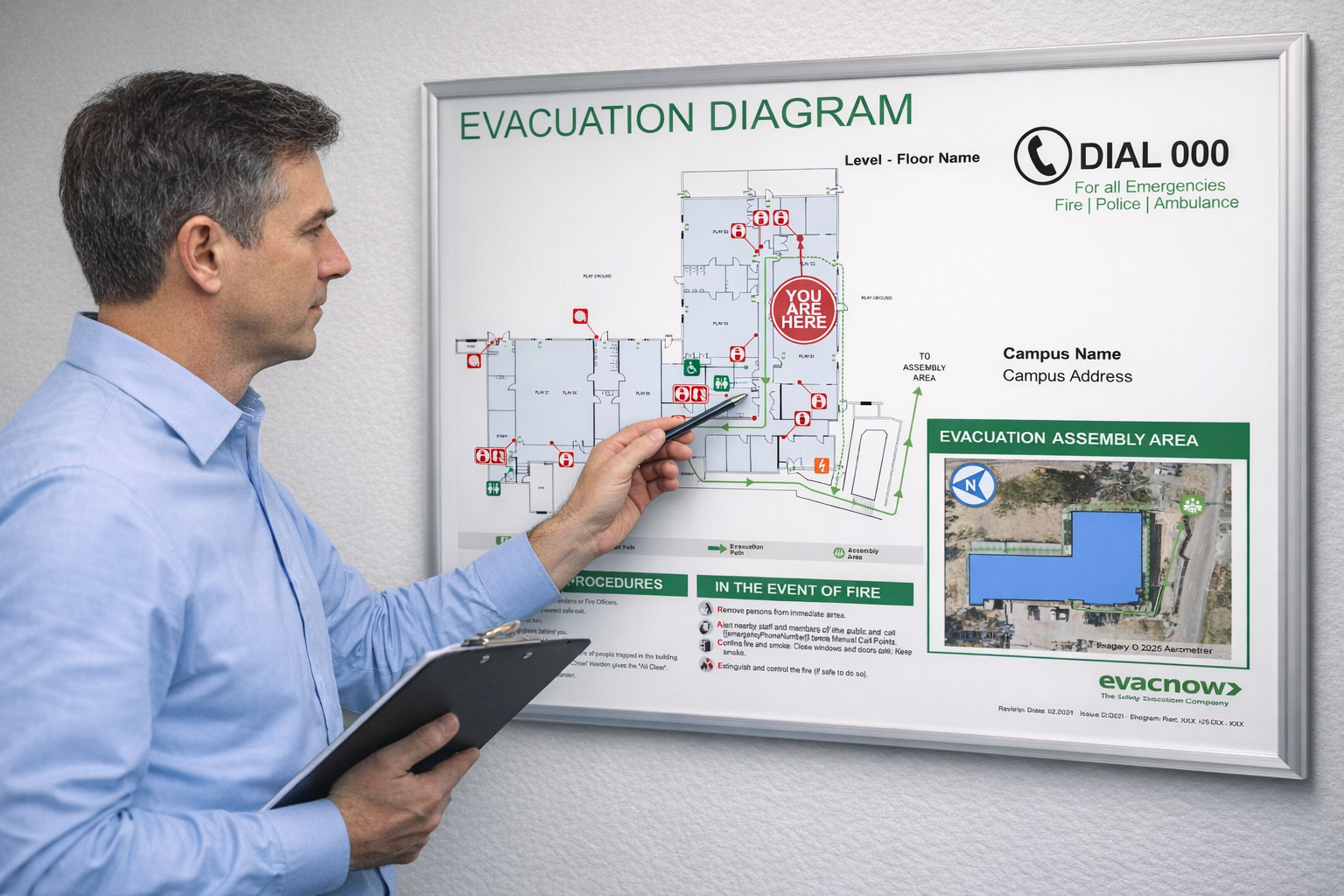
AS 3745-2010 requires that evacuation diagrams:
- Reflect the current layout of the building
- Show correct evacuation routes and exits
- Identify fire and emergency equipment
- Display the correct orientation (“You Are Here”)
- Include a diagram issue date and review period
Importantly, the Standard requires diagrams to be reviewed at least every 5 years.
In addition, they must be reviewed immediately after any relevant change to the building or emergency arrangements.
In other words, the 5-year mark is the minimum — not the only trigger.
When Must Evacuation Diagrams Be Updated?
Although the 5-year review cycle is well known, many updates are required much sooner. For example, evacuation diagrams must be revised if:
- Walls are moved or new rooms are created
- Tenancies expand or contract
- Exits are added, removed, or relocated
- Fire equipment is moved or replaced
- Emergency assembly areas change
- Accessibility routes are altered
Even small layout adjustments can make a diagram inaccurate. Consequently, if the map no longer matches reality, it may be considered non-compliant.
Why the 5-Year Review Matters
You might be thinking: If nothing has changed, why update it?
Firstly, the review ensures that diagrams are still legible and clearly displayed. Over time, diagrams can fade, become damaged, or be partially obstructed.
Secondly, regular review demonstrates due diligence during audits. Inspectors and regulators want to see documented evidence that emergency planning is being maintained — not ignored.
Therefore, even if the layout is unchanged, the review requirement still applies.
What Happens If You Don’t Update Them?
Failing to update evacuation diagrams can lead to:
- Non-compliance notices during audits
- Rectification deadlines
- Increased liability exposure
- Insurance complications
- Confusion during an actual emergency
More importantly, outdated evacuation diagrams can delay evacuation. In an emergency, people rely on visual guidance. If exits or equipment locations are incorrect, valuable seconds can be lost.
Who Is Responsible for Keeping Evacuation Diagrams Updated?
Responsibility typically sits with the Person Conducting a Business or Undertaking (PCBU). Depending on the building, this may include:
- Business owners
- Employers
- Building owners
- Facility managers
- Body corporates (for common areas)
In multi-tenant buildings, responsibilities are often split. For example, tenancy evacuation diagrams may fall to the tenant, while common area diagrams remain the building manager’s responsibility.
Therefore, clarity around responsibility is essential.
A Practical Compliance Approach
Rather than waiting five years and hoping nothing has changed, a smarter approach is:
- Review evacuation diagrams annually during safety checks
- Confirm layout accuracy after any refurbishment
- Update diagrams immediately when exits or equipment change
- Keep digital master files on record
Additionally, using professionally prepared evacuation diagrams makes updates far easier when required.
The Bottom Line
So, how often do evacuation diagrams need to be updated?
- Reviewed at least every 5 years
- Updated immediately after any relevant change
- Replaced if damaged, faded, or illegible
Ultimately, evacuation diagrams must always reflect the current building conditions. If they don’t, they are not compliant — regardless of their age.
Need to update your evacuation diagrams?
Request a quote if you’re unsure whether yours are due for review
Keeping evacuation diagrams accurate is one of the simplest ways to maintain compliance under AS 3745-2010 — and reduce risk across your facility.