

Short answer: Yes — in most cases, you do.
If you manage or operate a small business or office in Australia, evacuation diagrams are not just “nice to have” — they’re often a legal requirement and a critical part of workplace safety. Yet many businesses still assume evacuation diagrams only apply to large commercial buildings. That’s a risky assumption.
Below is a clear, no-nonsense breakdown of when evacuation diagrams are required, who’s responsible, and how small businesses can stay compliant without overcomplicating things.
When are evacuation diagrams required?
Under AS 3745 – Planning for Emergencies in Facilities, evacuation diagrams are required in most workplaces where people occupy a building, including:
-
Offices (single or multi-tenant)
-
Retail shops
-
Medical and allied health clinics
-
Warehouses and light industrial spaces
-
Hospitality venues
-
Commercial strata buildings
If your workplace has employees, customers, contractors, or visitors, you should expect evacuation diagrams to be required.
If someone unfamiliar with your premises could reasonably be inside the building, evacuation diagrams are expected.
What about small businesses?
Size doesn’t exempt you.
Even small offices or low-occupancy workplaces may require evacuation diagrams if they include:
-
More than one exit
-
Shared common areas
-
Fire safety equipment (extinguishers, hose reels, alarms)
-
A designated emergency assembly area
-
Tenancies within a larger building
Many small businesses fall under a shared building responsibility, meaning diagrams are required even if you lease a single suite.
Who is responsible for evacuation diagrams?
Responsibility usually sits with the Person Conducting a Business or Undertaking (PCBU) — which may be:
-
The business owner
-
The employer
-
The building owner or body corporate (for common areas)
In practice:
-
Tenancy diagrams often fall to the business or tenant
-
Common area diagrams usually fall to building management
If you’re unsure, it’s best to clarify early — lack of clarity doesn’t remove the obligation.
What must evacuation diagrams show?
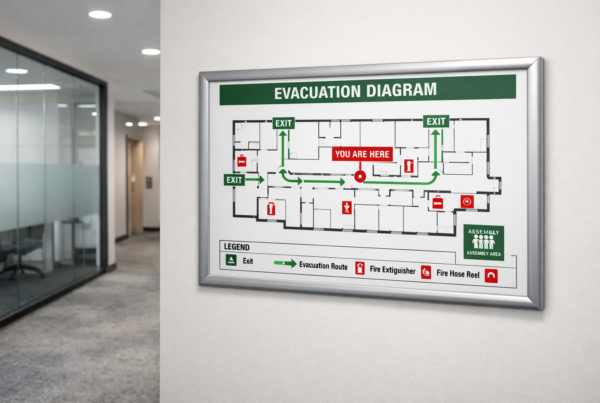
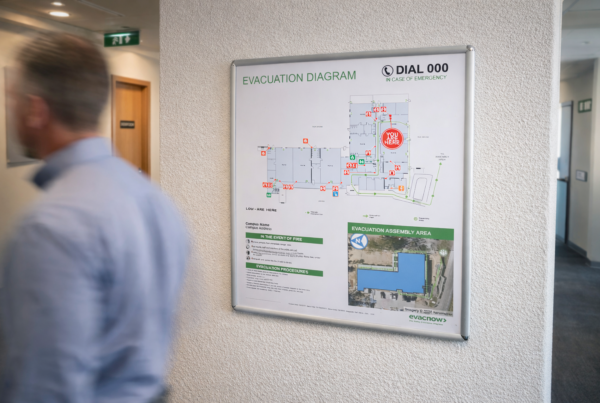
Compliant evacuation diagrams must clearly display:
-
Your current location (“You Are Here”)
-
Evacuation routes and exits
-
Fire and emergency equipment
-
Emergency assembly area
-
Orientation (correct north point)
-
Diagram issue date and validity
Diagrams must be:
-
Easy to read
-
Correctly oriented
-
Installed in visible locations
-
Reviewed at least every 5 years, or sooner if layouts change
Poor-quality or outdated diagrams can be just as non-compliant as having none at all.
What happens if you don’t have them?
Failing to provide evacuation diagrams can lead to:
-
Non-compliance with AS 3745
-
Issues during audits or WHS inspections
-
Increased risk during an actual emergency
-
Liability exposure if an incident occurs
More importantly — evacuation diagrams save time, reduce panic, and help people exit safely when it matters most.
The simple way to stay compliant
For small businesses and offices, compliance doesn’t need to be complex or expensive.
Modern services allow you to:
-
Upload floor plans online
-
Have diagrams professionally prepared by certified Fire Safety Advisors
-
Receive print-ready PDFs
-
Order without site visits
-
Install diagrams yourself or request delivery and printing
This approach keeps things fast, affordable, and compliant.