
Evacuation diagrams are not optional safety signage or a “best practice” extra — in Australia, they are a legal requirement in most workplaces and commercial buildings.
Yet many facility managers, strata managers and business owners only discover this during a fire audit, WHS inspection, or after a compliance notice has been issued.
Below is a clear, plain-English explanation of:
- What law requires evacuation diagrams
- What AS 3745 mandates
- Who is responsible
- What must be included
- What happens if diagrams are missing or non-compliant
What Law Requires Evacuation Diagrams?
Under Australian Work Health and Safety (WHS) legislation, employers and building managers must identify risks and provide clear emergency procedures for occupants. Evacuation diagrams form part of that legal obligation.
In addition, the Australian Standard:
AS 3745–2010 – Planning for Emergencies in Facilities
sets out the requirements for emergency planning, including evacuation diagrams.
While AS 3745 is a standard rather than legislation itself, it is widely referenced by:
- Workplace Health & Safety regulators
- Fire authorities
- Building compliance auditors
- Insurance providers
In practice, compliance with AS 3745 is treated as the benchmark for meeting emergency planning obligations.
Why Evacuation Diagrams Are Legally Required
Evacuation diagrams exist to ensure occupants can evacuate safely and efficiently during an emergency.
They ensure:
- Occupants can immediately identify exits
- Evacuation routes are clearly understood
- Fire and emergency equipment can be located quickly
- Visitors and unfamiliar occupants can exit safely
In an emergency, people don’t read emergency manuals — they follow what’s on the wall.
Without clearly displayed evacuation diagrams, a building may fail to meet its duty of care under WHS laws.
What Does AS 3745 Require?
AS 3745 specifies when evacuation diagrams are required, what they must contain, and how they must be displayed.
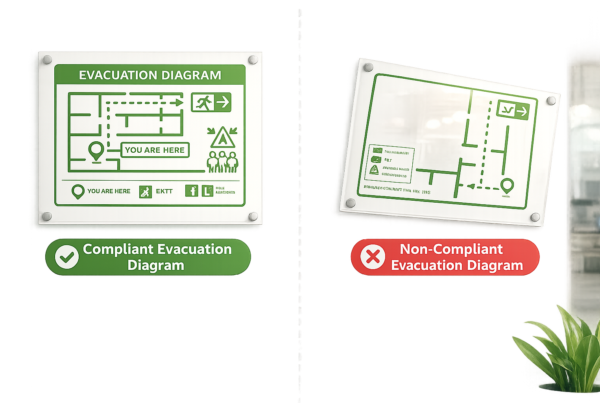
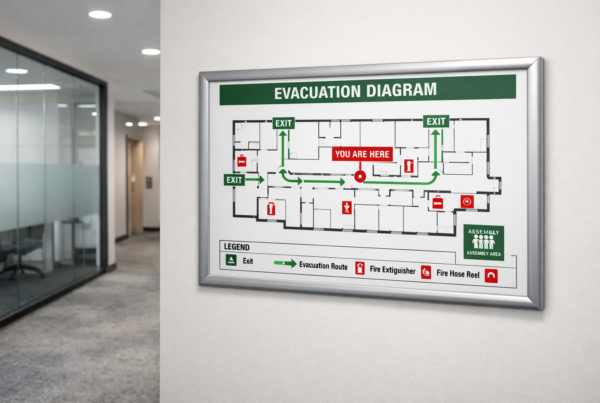
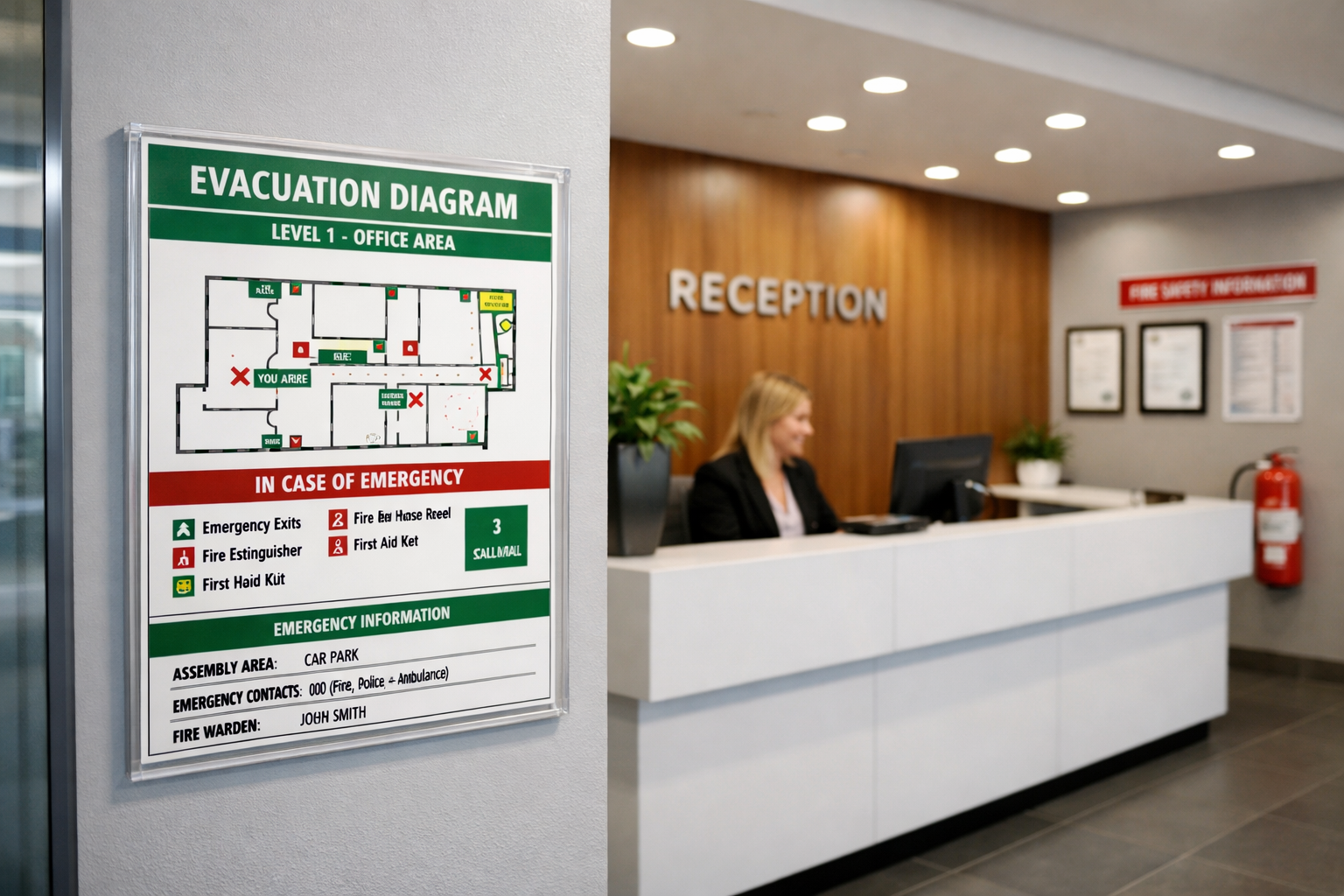
To be compliant, evacuation diagrams must include:
- A clearly marked “You Are Here” location
- Evacuation routes and exits
- Fire and emergency equipment (extinguishers, hose reels, alarms)
- The designated emergency assembly area
- A north point for correct orientation
- The diagram issue date and review period
They must also be:
- Clearly legible
- Correctly oriented to the viewer
- Installed in prominent and logical locations
- Reviewed at least every five (5) years
- Updated whenever building layouts or fire equipment change
Having “a diagram” is not enough.
It must meet AS 3745 requirements to be considered compliant.
Who Must Comply?
Evacuation diagrams are required in most buildings where people work or gather, including:
- Offices and commercial workplaces
- Retail stores and shopping centres
- Warehouses and industrial facilities
- Medical and allied health premises
- Hospitality venues
- Shared and strata buildings
If your building has:
- Employees
- Customers or visitors
- More than one exit
- Fire safety equipment
…evacuation diagrams are almost always required.
Who Is Responsible for Evacuation Diagram Compliance?
Responsibility typically sits with the Person Conducting a Business or Undertaking (PCBU) under WHS legislation.
Depending on the building structure, this may include:
- The employer or business owner
- The building owner
- The body corporate
- The facility manager
In many cases:
- Tenancy evacuation diagrams are the tenant’s responsibility
- Common area diagrams are the building manager’s responsibility
Uncertainty does not remove responsibility — it increases risk.
What Happens If Evacuation Diagrams Are Non-Compliant?
Failing to provide compliant evacuation diagrams can lead to:
❌ Non-Compliance Notices
Issued during WHS audits, fire inspections, or safety reviews.
❌ Increased Legal Liability
If an incident occurs, lack of compliant evacuation diagrams can expose business owners and managers to prosecution or civil claims.
❌ Insurance Complications
Insurers may question coverage if emergency planning obligations have not been met.
❌ Increased Risk to Occupants
During an emergency, unclear evacuation information can cause confusion, delay, or injury.
In short — missing or outdated evacuation diagrams create both safety and compliance risk.
How Often Must Evacuation Diagrams Be Reviewed?
AS 3745 recommends evacuation diagrams be reviewed:
- At least every five (5) years
- Whenever building layouts change
- When fire equipment is relocated or added
- Following significant renovations
Outdated diagrams are one of the most common issues identified during fire safety audits.
Need AS 3745-Compliant Evacuation Diagrams?
Evacuation diagrams are legally required in Australia for a reason — they reduce panic, guide occupants, and support safe evacuation during emergencies.
If your diagrams are outdated, missing, or prepared incorrectly, they may not meet current compliance expectations.
EvacNow prepares certified, audit-ready evacuation diagrams for businesses across Australia.
FAQ – Evacuation Diagram legal requirements
Are evacuation diagrams legally required in Australia?
Yes. Under AS 3745–2010 and various state fire safety regulations, evacuation diagrams are required in many commercial and shared-use buildings.
How often must evacuation diagrams be reviewed?
AS 3745 recommends review every five years or whenever building layout or fire equipment changes.
Who is responsible for evacuation diagram compliance?
Typically the building owner or occupier, depending on lease arrangements and state regulations.
Can outdated evacuation diagrams fail a fire audit?
Yes. Outdated, incorrect or missing diagrams are commonly flagged during compliance inspections.