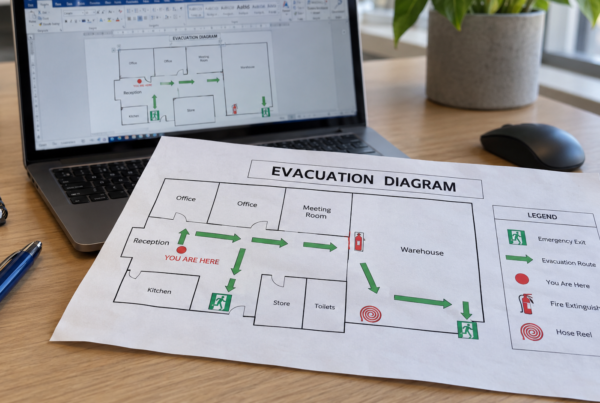

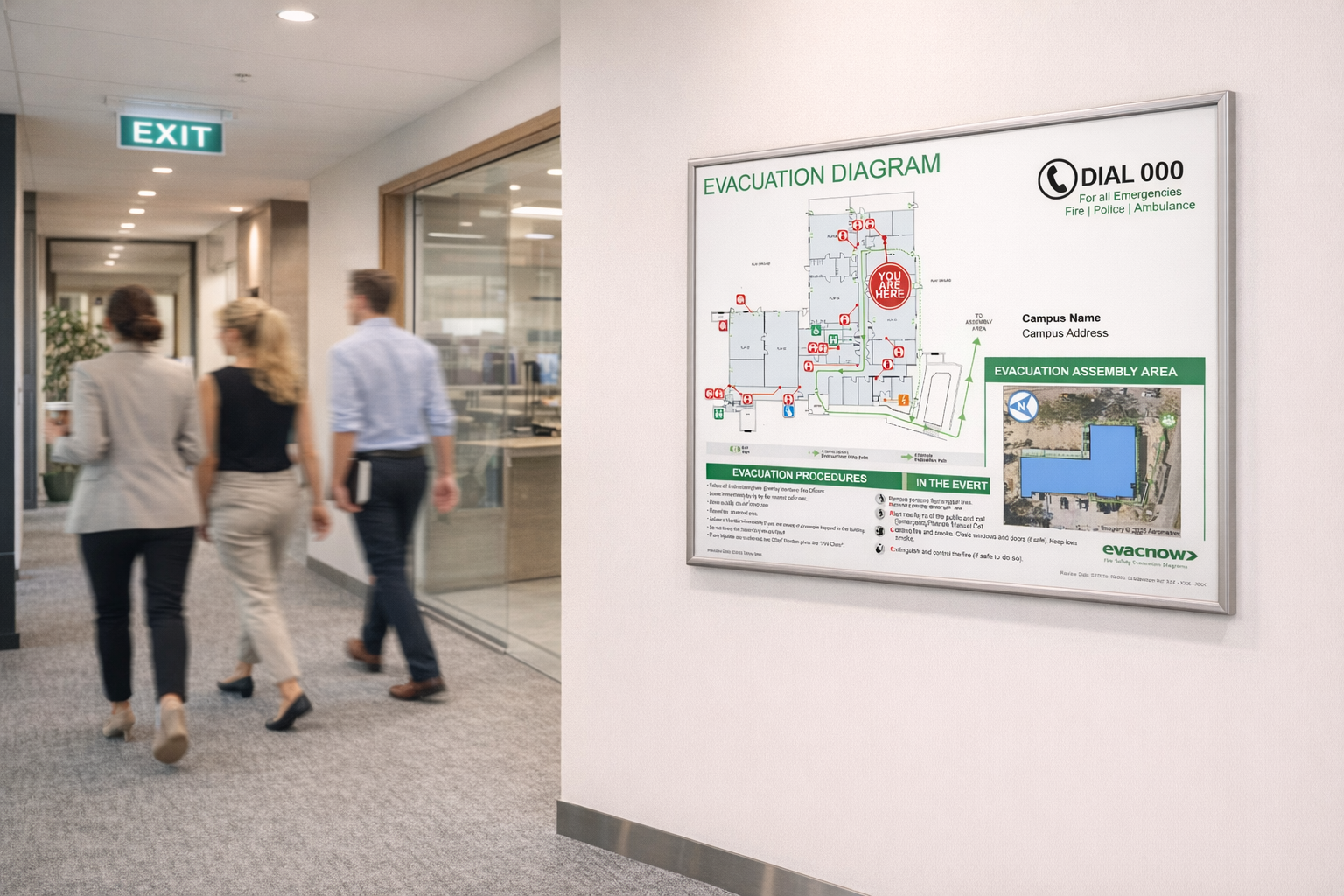
Do Small Businesses Need Evacuation Diagrams?
Many people ask whether evacuation diagrams for small businesses are actually required, especially in smaller offices or tenancies. If you run or manage a small business or office, it’s easy to assume evacuation diagrams are only required for large buildings.
In reality, many smaller workplaces are still expected to have compliant evacuation diagrams — and this is something that often gets overlooked until an inspection or audit.
In many cases, yes — small businesses and offices do require evacuation diagrams.
It’s not strictly about the size of the business. Requirements are based on things like:
- Number of occupants
- Layout of the building
- Type of work being carried out
- Whether an emergency plan is required
If your workplace has staff, visitors, or any level of fire risk, there’s a strong chance evacuation diagrams should be in place.
When Are Evacuation Diagrams Required?
While every site is different, evacuation diagrams are generally expected in:
- Offices with multiple staff or visitors
- Tenancies within larger commercial buildings
- Workplaces with defined emergency procedures
- Buildings fitted with fire equipment (extinguishers, hose reels, alarms)
- Sites where occupants may not be familiar with exits
If your workplace falls into any of the above, it’s worth assuming diagrams are required unless confirmed otherwise.
What We See on Site (Real-World)
From a Fire Safety Advisor perspective, smaller businesses are where the most gaps show up.
Common issues include:
- No evacuation diagrams at all
- Diagrams that haven’t been updated in years
- Layouts that no longer match the actual space
- Missing or incorrect fire equipment locations
On the surface everything looks fine… until someone actually checks it.
“We’re Too Small to Need Them” — Not Always True
This is probably the most common assumption.
But in practice, compliance isn’t based on business size — it’s based on risk and usability.
Even a small office can:
- Have multiple exits
- Contain fire equipment
- Host visitors unfamiliar with the layout
In those cases, evacuation diagrams are not just helpful — they’re expected.
What Happens If You Don’t Have Them?
Most of the time, it doesn’t come up… until it does.
Evacuation diagram issues are usually identified when:
- A fire safety inspection is carried out
- A building audit takes place
- A tenancy changes hands
- Or something goes wrong during an emergency
At that point, you’re reacting instead of staying ahead.
Typical outcomes include:
- Non-compliance being flagged
- Requests to update or install diagrams
- Delays with approvals or certifications
Quick Compliance Check
Ask yourself:
- Are evacuation diagrams clearly displayed in your workplace?
- Do they match the current layout?
- Are exits and fire equipment accurately shown?
- Is there a clear “You Are Here” marker?
- Have they been reviewed in the last 5 years?
If you’re unsure on any of the above, it’s worth taking a closer look.
Are Evacuation Diagrams Mandatory in Australia?
Evacuation diagrams are typically required as part of a broader emergency planning framework under AS 3745 – Planning for emergencies in facilities.
If your building or workplace requires an emergency plan, evacuation diagrams are generally expected to support it.
Requirements can vary depending on the building type and state regulations, but the standard is widely recognised as the benchmark during audits and inspections.
When Might They Not Be Required?
There are some cases where evacuation diagrams may not be necessary, such as:
- Very small, simple layouts
- Sole occupancy with no visitors
- Minimal fire risk and straightforward exit access
That said, these situations are less common than most people think.
Not Sure Where You Stand?
If you’re unsure whether your workplace requires evacuation diagrams, or whether your current ones would pass an audit, it’s worth checking before it gets picked up later.
Send us an enquiry to check where if it’s required at your site.
Compliant Evacuation Diagrams, Done Properly
We provide evacuation diagrams prepared in accordance with AS 3745, reviewed by a Certified Fire Safety Advisor, and delivered Australia-wide.
No guesswork — just diagrams that are designed to meet real-world compliance requirements.